Epidural Birth Plan: Free Template and What to Expect
Last reviewed on October 11, 2026
About 7 in 10 people giving birth vaginally in the US use an epidural or spinal. Planning on one doesn't make a birth plan pointless. It just changes what goes in it. This guide covers what to expect and gives you a free one-page epidural birth plan.
Quick Answer: What Goes in an Epidural Birth Plan?
- Timing: as soon as you ask, or once active labor is established
- What to use while you wait: shower, birth ball, nitrous oxide or IV medication
- Type: a low-dose epidural, plus a patient-controlled (PCEA) button if your hospital offers one
- Comfort and positions: change sides regularly and use a peanut ball
- Pushing, skin-to-skin, cord clamping, feeding, and a cesarean backup that uses your epidural
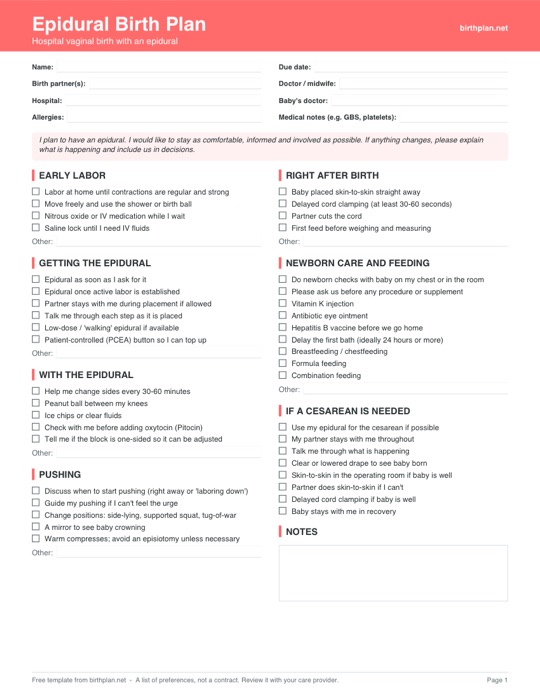
Free Printable Epidural Birth Plan
A one-page fillable PDF for a hospital birth with an epidural. Type into it on screen or print it and tick your choices. It's also available as an editable Word file.
Download PDF Download WordHow an Epidural Works
An epidural is a thin, flexible tube (catheter) placed in your lower back, just outside the membrane around your spinal cord. Local anesthetic and usually a small dose of opioid flow through it continuously, numbing the nerves that carry pain from your uterus and birth canal.
- IV fluids first. You'll have an IV line, and often a bag of fluid, because an epidural can lower your blood pressure.
- Positioning. You sit on the edge of the bed curled forward, or lie on your side. Your partner can often stay and hold your hands.
- Placement. After a numbing injection in the skin, the anesthesiologist places the needle and threads the catheter, then removes the needle. You need to stay still through contractions, which usually takes 10–20 minutes.
- Taking effect. Relief builds over about 10–20 minutes. You'll have continuous fetal monitoring, regular blood pressure checks, and usually a bladder catheter, because you won't feel when you need to pee.
When to Ask for an Epidural
There's no rule that you must reach a certain number of centimeters. The American College of Obstetricians and Gynecologists says a request for pain relief is reason enough. In practice:
- Early labor is often best managed at home or with other methods. Some hospitals prefer to wait until active labor (around 6 cm).
- Ask before you think you'll need it. The anesthesiologist may be with another patient or in the operating room, so there can be a wait.
- "Too late" usually means the baby is about to be born, or you can't stay still long enough for placement. Even at 9–10 cm, there may still be time.
If you'd like to try unmedicated coping first, say so in your plan, along with how you'd like to be offered the epidural. The natural pain relief guide covers the options.
Types: Standard, Low-Dose and Combined Spinal-Epidural
| Type | What it is | Why you might ask for it |
|---|---|---|
| Low-dose epidural | The standard in most US hospitals today: a dilute mix of anesthetic and opioid. | Good pain relief while you can usually still shift your legs and feel pressure to push. |
| Combined spinal-epidural (CSE) | A single spinal dose for fast relief, followed by the epidural catheter. | Relief within minutes, which helps if labor is moving quickly. Sometimes called a "walking epidural". |
| Patient-controlled epidural (PCEA) | A button you press to give yourself an extra dose, within safe limits. | Lets you top up when pain breaks through, without waiting for the anesthesiologist. |
Even with a low-dose or "walking" epidural, most hospitals won't let you walk the halls. You can usually still sit up, kneel, and change position in bed.
Side Effects and Risks
Epidurals are very safe, but it's worth knowing what's common:
- Lower blood pressure, which is treated with fluids and medication. This is why you'll have an IV.
- Itching, shivering or nausea, which usually wear off or can be treated
- Patchy or one-sided relief. Tell your nurse, because the catheter can often be adjusted or replaced.
- Fever during a long labor is more common with an epidural, and may lead to extra checks for your baby
- A longer pushing stage, and a modest increase in the use of oxytocin
- Severe headache after the birth (post-dural puncture headache) in about 1 in 100. It's treatable, including with a blood patch.
Cochrane reviews of dozens of trials have found that epidurals do not increase the chance of a cesarean. Serious complications such as nerve damage or infection are rare.
You may not be able to have an epidural if you have a very low platelet count, take certain blood thinners, have an infection in your back, or have some spinal conditions. Ask about this at a prenatal visit, not in labor.
Preferences to Include
Before the epidural
- Laboring at home until contractions are regular and strong
- A saline lock until IV fluids are needed
- Shower, birth ball, nitrous oxide or IV medication while you wait
- Your partner staying in the room during placement, if your hospital allows it
Once the epidural is in
- Help to turn side to side every 30–60 minutes, which may help the baby rotate and descend
- A peanut ball between your knees. Some studies link it to a shorter labor.
- A PCEA button, if available
- Ice chips or clear fluids
- Being asked before oxytocin is started or increased
- Dim lights and rest. Many people sleep once the epidural works.
Right after birth
An epidural doesn't stop immediate skin-to-skin, delayed cord clamping, your partner cutting the cord, or a first feed before weighing. List them as you would in any hospital birth plan.
If you need a cesarean
An epidural that's already in can usually be topped up for surgery, so you stay awake and your partner can be with you. Add the cesarean preferences that matter to you, such as a lowered drape and skin-to-skin in the operating room.
Pushing With an Epidural
With a modern low-dose epidural, many people still feel pressure when it's time to push. If you can't feel the urge, your nurse will guide each push using the monitor.
- Pushing right away vs. "laboring down." Laboring down means waiting an hour or so after full dilation for the baby to descend. A large 2018 trial found it didn't increase the chance of a vaginal birth, and it was linked to slightly more infection and bleeding. Many hospitals now encourage pushing at full dilation. Ask what your hospital recommends.
- Positions. Try side-lying, semi-sitting, a supported squat with a squat bar, or "tug-of-war" with a sheet.
- Turning the epidural off to push isn't recommended in most cases. Studies show it doesn't shorten pushing or reduce assisted births, and it brings the pain back.
- Ask for a mirror so you can see your progress, along with warm compresses and no episiotomy unless needed.
Sample Epidural Birth Plan
Copy and adapt this example, or download the printable template. For more filled-in plans, see our birth plan examples.
Birth Plan for Taylor Brooks
Due date: June 2 | Partner: Jordan | OB: Dr. Lee | GBS: positive (antibiotics) | Allergies: penicillin (rash)
Thank you for caring for us. I'm planning an epidural and would like to stay comfortable and involved. If anything changes, please explain and include us in decisions.
Our top three:
- Epidural when I ask for it, with a PCEA button if possible
- Help me change position regularly and use a peanut ball
- Immediate skin-to-skin and delayed cord clamping
Before the epidural: Shower and birth ball. Saline lock until I need fluids.
With the epidural: Please ask me before starting Pitocin. Dim lights so we can rest.
Pushing: Guide me if I can't feel the urge. I'd like a mirror, warm compresses, and no episiotomy unless needed.
If a cesarean is needed: Please top up my epidural so I can stay awake. Jordan comes with me, and we'd like skin-to-skin in the OR if baby is well.
Baby: Vitamin K, eye ointment and hep B are fine. Delay the bath. Breastfeeding, and please ask before giving formula or a pacifier.
Frequently Asked Questions
Do I need a birth plan if I'm getting an epidural?
Yes. An epidural only covers pain relief. Your plan still tells the team when you'd like it, how you want to move and rest, how you'd like to push, and your wishes for skin-to-skin, cord clamping, feeding, newborn care and a possible cesarean.
When is it too late to get an epidural?
There's no set number of centimeters. You can usually have one at any point, as long as you can stay still for 10–20 minutes while it's placed and there's time for it to work before the birth. Tell your nurse early if you think you'll want one.
Does an epidural slow down labor or increase the risk of a C-section?
Large reviews have found that epidurals don't increase the chance of a cesarean. They can lengthen the pushing stage a little and are linked to more use of oxytocin. Modern low-dose epidurals affect pushing less than older, stronger ones.
Can you move or walk with an epidural?
Most people can't walk safely with a standard epidural. You can still change position in bed every 30–60 minutes, use a peanut ball, and sit upright. A low-dose or combined spinal-epidural leaves more leg strength, but you'll usually stay near the bed.
Make Your Epidural Birth Plan
Download the free template and tick your choices, or let the generator write a personalized plan for you.
Download the Epidural Template Use the Birth Plan GeneratorThis page is for general education and isn't medical advice. Anesthesia practices vary by hospital, so talk to your doctor, midwife or anesthesiologist about your situation. See our medical disclaimer.