Birth Preferences Template (UK): Free Birth Plan in PDF & Word
Last reviewed on 1 October 2026
A free, one-page birth preferences sheet written for maternity care in the UK. It uses the words your midwife uses (labour ward, birth centre, gas and air, physiological third stage) and leaves out US-only items like routine eye ointment. Fill it in on screen, edit it in Word, or print it on A4.
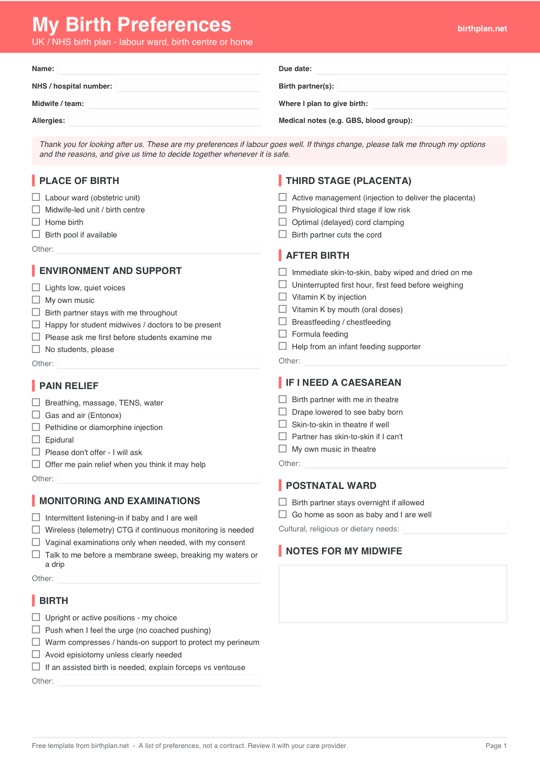
Free UK Birth Preferences Template
One A4 page with tick boxes and write-in lines for place of birth, environment and students, pain relief, monitoring and examinations, birth, the third stage, skin-to-skin and feeding, vitamin K, a caesarean backup and the postnatal ward.
Quick Answer
Birth preferences are the UK name for a birth plan: a short list of what you'd like if labour goes well, and what matters to you if it doesn't. Draft yours in the second or early third trimester, talk it through with your midwife (usually by your 36-week appointment), then add it to your maternity notes and pack a printed copy in your hospital bag.
Why "Birth Preferences" Instead of "Birth Plan"?
Many NHS trusts and midwives prefer the term birth preferences because birth can't really be planned. The document tells your team what you'd like and why, and shows you know things may change. Practically, it's the same thing as a birth plan, and the template works whichever name your trust uses.
Most trusts have a birth preferences page in their digital maternity notes app or paper notes. You can fill that in directly, or use this template to think it through first and then copy your choices across or upload it.
What to Include: Section by Section
1. Place of birth
In the UK you can usually choose between four settings, depending on your health and pregnancy:
- Home, with NHS community midwives
- Freestanding midwife-led unit (birth centre on a separate site from a hospital)
- Alongside midwife-led unit (birth centre in the same building as a labour ward)
- Obstetric unit / labour ward, with doctors, epidurals and theatres on hand
NICE guidance says midwife-led settings are particularly suitable for low-risk women and birthing people, and home birth is particularly suitable if you've given birth before. Your midwife will help you decide. If your pregnancy becomes higher risk, you may be advised to give birth on the labour ward. Read more in our guide to choosing a birth setting and our home birth plan.
2. Environment, birth partners and students
Note who you'd like with you (many units allow up to two birth partners in labour), whether you'd like the lights low and your own music, and whether you're happy for student midwives or doctors to be present or to examine you. You can say yes, no, or "please ask me first." Declining won't affect your care.
3. Pain relief
UK options, from least to most medical:
- Breathing, massage, movement, water (bath or birth pool) and a TENS machine
- Gas and air (Entonox): available in all settings, including at home
- Opioid injection (pethidine or diamorphine): available in most hospitals and some birth centres
- Epidural: only on the labour ward, so a transfer is needed from home or a birth centre
Some units offer other options such as remifentanil. Ask at your antenatal appointments. Tell your midwife how you'd like pain relief offered: "please offer me options" or "please don't offer, I'll ask." See our full guide to pain relief in labour.
4. Monitoring and examinations
If you and your baby are low risk, NICE recommends intermittent auscultation: the midwife listens to the baby's heart regularly with a handheld Doppler or Pinard. If you have risk factors, you'll usually be offered continuous monitoring (CTG); ask whether wireless (telemetry) monitoring is available so you can stay mobile or use the pool. Vaginal examinations are offered, not required. You can ask for them only when they'll help a decision.
5. Induction and going overdue
NICE recommends discussing induction from 41 weeks, and you'll usually be offered a membrane sweep beforehand. You can accept, decline or ask for more monitoring instead. Note what you'd like to discuss, and read the information your trust provides.
6. The birth
Include your preferred positions, whether you'd like to push spontaneously or be guided, help to protect your perineum (warm compresses, hands-on support, slow birth of the head), and what you'd like explained if an assisted birth (forceps or ventouse) is recommended.
7. Third stage (delivering the placenta)
- Active management: an injection as the baby is born, then the placenta is delivered with gentle traction. NICE recommends this because it lowers the risk of heavy bleeding.
- Physiological third stage: no injection; the placenta comes naturally, which can take up to an hour. An option if you're low risk and well informed; you can switch to active management at any time.
Either way, delayed (optimal) cord clamping is now standard when the baby is well. Note who would like to cut the cord.
8. After the birth and your baby
- Skin-to-skin straight away and an undisturbed first hour, with the first feed before weighing
- Vitamin K: offered to all babies to prevent a rare bleeding disorder. One injection is recommended; oral doses are an alternative.
- Feeding: breastfeeding, formula or both, and whether you'd like help from an infant feeding supporter
- Your baby will also be offered a newborn physical examination within 72 hours, a hearing test, and the blood spot (heel prick) test at about 5 days. You don't need to list these unless you have questions.
9. If you need a caesarean
Even an unplanned caesarean has choices: your birth partner in theatre, the drape lowered to see your baby born, skin-to-skin in theatre, your partner holding baby skin-to-skin if you can't, and your own music. If you're planning a caesarean, see our caesarean birth plan.
10. Postnatal ward
Some units let a birth partner stay overnight. Note any dietary, cultural or religious needs, and whether you'd like to go home as soon as you and your baby are well.
UK and US Birth Plan Terms
Many birth plan templates online are written for US hospitals. If you're using one in the UK, these are the terms to swap:
| UK term | US term | Notes |
|---|---|---|
| Labour ward / obstetric unit | Labor and delivery (L&D) | |
| Birth centre / midwife-led unit | Birth center | UK birth centres are usually NHS-run |
| Gas and air (Entonox) | Nitrous oxide | Widely used in the UK, less common in the US |
| Syntocinon drip | Pitocin | Synthetic oxytocin to start or speed up labour |
| Theatre | Operating room (OR) | |
| Caesarean section | Cesarean / C-section | |
| Postnatal ward | Postpartum / mother-baby unit | |
| Nappies | Diapers | Hospital bag lists differ too |
| Not routine | Erythromycin eye ointment | Not routinely given to newborns in the UK |
| Hepatitis B at 8 weeks (6-in-1) | Hepatitis B vaccine at birth | UK babies get a birth dose only if at increased risk |
Tips for Writing Birth Preferences Your Midwife Will Read
- Keep it to one page. The midwife caring for you may meet you for the first time in labour.
- Put your top three priorities first, and mention anything that would help you feel safe, such as a previous traumatic birth, anxiety, or how you'd like things explained.
- Mention a previous birth if it's relevant, especially a caesarean (see VBAC) or a difficult experience.
- Use "I'd prefer" rather than "I refuse." You always keep the right to accept or decline any care, and flexible wording keeps the conversation open.
- Want a worked example? See our birth plan examples.
Frequently Asked Questions
What is the difference between a birth plan and birth preferences?
They're the same document. Many NHS trusts and midwives say "birth preferences" because it makes clear the document describes what you'd like if labour goes well, rather than a fixed plan, and that choices may change for safety or because you change your mind.
When should I write my birth preferences in the UK?
Start thinking about your preferences in the second trimester and have a draft ready to discuss with your midwife by your 36-week appointment, when preparing for labour and birth is usually covered. Add the final version to your maternity notes or app and keep a printed copy in your hospital bag.
Where do I put my birth plan in my NHS notes?
Many trusts have a birth preferences section in the digital maternity notes app or in paper hand-held notes. Ask your midwife which your trust uses. You can also upload a completed template and bring a printed copy so the midwife looking after you in labour can read it quickly.
Can I say no to student midwives or doctors?
Yes. Students play an important part in training future midwives and doctors, and many people are happy to have them, but you can decline or ask to be asked first, especially before any examination. Your care won't be affected. Note your wishes in your birth preferences so staff know.
Can I ask for a caesarean in the UK?
Yes. NICE guidance says that if you ask for a caesarean without a medical reason, your team should discuss the benefits and risks with you and offer support, including perinatal mental health support if you're anxious about birth. If you still want a caesarean after that discussion, a planned caesarean should be offered, although an individual obstetrician may refer you to a colleague.
Sources: NICE guideline NG235 Intrapartum care (2023); NICE guideline NG207 Inducing labour (2021); NICE guideline NG192 Caesarean birth (2021); NHS: Your birth plan; NHS: Vitamin K for newborns. This page is for information only and doesn't replace advice from your midwife or doctor.
Get Your Free Template
Download the A4 birth preferences sheet, or answer a few questions in the generator and print a personalised plan.
Download the PDF Use the Generator