Induction Birth Plan: Free Template and What to Expect
Last reviewed on October 11, 2026
Around one in three labors in the US now starts with an induction. Being induced changes how labor begins, but it doesn't mean giving up your preferences. This page explains how induction works and gives you a free one-page induction birth plan to fill in and take to the hospital.
Quick Answer: What Goes in an Induction Birth Plan?
- The basics: your induction date, the reason, how many weeks pregnant you'll be, and your GBS status
- Method preferences: balloon or medication to ripen the cervix, and whether you'd like to go home while it works
- Oxytocin (Pitocin): start low, increase slowly, and turn down once labor is established if it's safe
- Staying mobile: a wireless monitor, upright positions, a birth ball or peanut ball
- Pain relief, birth and newborn wishes, and a plan for what happens if labor doesn't progress
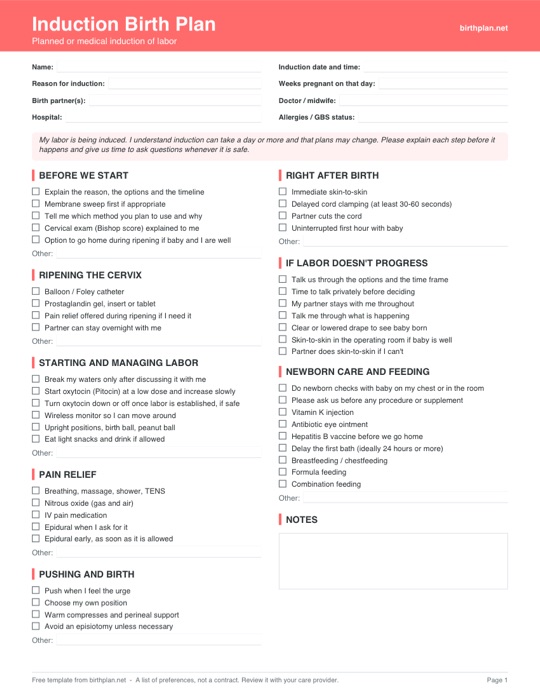
Free Printable Induction Birth Plan
A one-page fillable PDF with checkboxes for every stage of an induction. Type into it on screen or print it and tick by hand. Bring 3–4 copies on induction day.
Download PDF Download WordWhy Labor Is Induced
Induction means using medication or a physical method to start labor before it starts on its own. Your provider might suggest it when continuing the pregnancy carries more risk than delivering the baby. Common reasons include:
- Going past your due date, usually offered from 41 weeks and recommended by 42 weeks
- Waters breaking without contractions (prelabor rupture of membranes), because the risk of infection rises with time
- High blood pressure or preeclampsia
- Diabetes, either gestational or pre-existing
- Concerns about the baby, such as slowed growth, low amniotic fluid or reduced movements
- Elective induction at 39 weeks. After the 2018 ARRIVE trial, many US hospitals offer this to first-time parents at low risk. In the trial it slightly lowered the cesarean rate (18.6% vs 22.2%).
Write the reason on your plan. It helps every new nurse or midwife understand the context, and it reminds you to ask whether the reason affects your other preferences (for example, preeclampsia usually means continuous monitoring and IV magnesium).
How Induction Works, Step by Step
Most inductions follow the same sequence. You may skip steps if your body is already getting ready for labor.
1. Checking your cervix (Bishop score)
Your provider checks how soft, thin, open and low your cervix is, and where the baby's head sits. These give a Bishop score. A score of 8 or more means your cervix is "favorable" and labor will probably start without much help. A low score (6 or less) usually means the cervix needs ripening first.
2. Membrane sweep (optional, before induction day)
During an internal exam, the midwife or doctor runs a finger around the inside of the cervix to separate the membranes. This releases prostaglandins and can bring on labor within 48 hours, sometimes avoiding a formal induction. It can be uncomfortable and cause spotting. In the UK it's routinely offered from 39–40 weeks.
3. Ripening the cervix
| Method | How it works | Good to know |
|---|---|---|
| Balloon catheter (Foley or Cook) | A small balloon is placed through the cervix and filled with water. The pressure gently opens it to about 3–4 cm. | No medication, so less risk of overly strong contractions. Some hospitals let you go home with it in. Often used for VBAC. |
| Prostaglandin insert or gel (dinoprostone: Cervidil, Prepidil; UK: Propess, Prostin) | Medication placed in the vagina that softens the cervix over 12–24 hours. | The insert can be pulled out quickly if contractions get too strong. Generally avoided after a previous cesarean. |
| Misoprostol (Cytotec) | A small tablet taken by mouth or placed vaginally every few hours. | Widely used and inexpensive. Not used after a previous cesarean. |
Some hospitals combine a balloon with misoprostol, which can shorten the time to birth. Ask what your hospital usually does and whether you can choose.
4. Breaking your waters (amniotomy)
Once the cervix is open enough, the provider can break the bag of waters with a small plastic hook. It shouldn't hurt more than a normal vaginal exam. Contractions often get stronger afterward, and labor usually needs to follow within about 24 hours because of the infection risk.
5. Oxytocin (Pitocin, or "the drip")
Synthetic oxytocin is given through an IV and increased every 30–40 minutes until contractions are regular and strong. You'll usually have continuous fetal monitoring while it runs. A wireless (telemetry) monitor lets you stand, sway and use a birth ball. Many hospitals have one, but you may need to ask for it.
How Long Does an Induction Take?
This is the question most people wish they'd asked. Rough timelines:
- Favorable cervix: labor often starts within a few hours of breaking your waters and starting oxytocin.
- Unfavorable cervix, first baby: ripening alone commonly takes 12–24 hours, and the whole process can stretch over two or three days.
- If you've had a vaginal birth before: things usually move noticeably faster.
Long gaps with little happening are normal, especially during ripening. Rest, eat if you're allowed, and save your energy for active labor. Some couples treat the first evening like a hotel stay, with a film, snacks and an early night.
If labor doesn't start after ripening and oxytocin, it's called a failed induction. Your options then usually include another round of ripening, a rest and a restart, going home if you and the baby are well, or a cesarean. Put a line in your plan asking to talk through all of them.
Preferences You Can Still Have
Induction changes how labor starts. Most of what happens after that is still up to you. These preferences are realistic for most inductions:
During the induction
- An explanation of each step and why, before it happens
- A balloon instead of medication, or the other way round, where it's safe
- Going home during cervical ripening if your hospital offers outpatient induction
- Oxytocin started at a low dose, increased slowly, and turned down or off once active labor is established if you and the baby are doing well
- A saline lock between doses instead of a continuous IV, when oxytocin isn't running
- Your partner staying overnight
During labor and birth
- A wireless monitor so you can move, plus a birth ball and a peanut ball
- Eating light snacks and drinking clear fluids, if your hospital allows it
- Your pain relief choices. Induced contractions can build quickly and feel intense, so it helps to decide ahead of time whether you want an epidural early or would rather try other methods first.
- Pushing positions, perineal support, and avoiding an episiotomy unless it's needed
- Immediate skin-to-skin, delayed cord clamping, and an uninterrupted first hour
Some inductions, especially first-time ones, end in a cesarean, so add a short cesarean backup section. The template includes one.
Questions to Ask Before You Agree
A simple way to remember them is BRAIN: Benefits, Risks, Alternatives, Intuition, and what happens if we do Nothing (or wait).
- Why are you recommending induction, and how urgent is it?
- What happens if we wait a few days with extra monitoring?
- What is my Bishop score, and which method would you start with?
- Can I go home during ripening?
- How long do inductions usually take here for someone like me?
- Will I need continuous monitoring, and is a wireless monitor available?
- Can I eat during the induction?
- When would you recommend a cesarean, and what are the alternatives at that point?
See how to discuss your birth plan with your doctor for more on these conversations.
Sample Induction Birth Plan
Copy and adapt this example, or download the printable template and tick your choices.
Induction Birth Plan for Sam Rivera
Induction: Tuesday 7 pm, 41+1 weeks (post-dates) | Partner: Chris | GBS: negative | Allergies: none
Thank you for looking after us. We know inductions can take time and plans may change. Please explain each step before it happens.
Our top three:
- Explain each step and give us a few minutes to talk before any new intervention
- Wireless monitoring so I can stay upright and moving
- Immediate skin-to-skin and delayed cord clamping
Induction:
- I'd prefer a balloon catheter first if my cervix needs ripening
- Please start Pitocin low and increase slowly, and turn it down once I'm in active labor if baby is doing well
- Please discuss breaking my waters with me first
Pain relief: Shower, birth ball and nitrous oxide first. I'll ask for an epidural if I want one.
Birth: Push when I feel the urge, in whatever position feels right. Warm compresses, and no episiotomy unless needed.
If labor doesn't progress: Talk us through all the options, including a rest or a second round of ripening. If we need a cesarean, Chris stays with me, and we'd like a lowered drape and skin-to-skin in the OR.
Baby: Vitamin K and eye ointment are fine. Please delay the bath. We plan to breastfeed.
What to Pack for an Induction
Pack your usual hospital bag, plus a few extras for a stay that can run into a second or third day:
- Snacks and drinks for you and your partner, and change for vending machines
- Downloaded films, a book, cards or a puzzle for the slow hours
- A pillow, eye mask, earplugs and a long phone charging cable
- Comfortable clothes for walking the halls during ripening
- An extra change of clothes for your partner
Eat a proper meal before you leave home, and call the labor unit before you set off. Inductions are sometimes delayed when the unit is busy.
Frequently Asked Questions
Can you have a birth plan if you are being induced?
Yes. Most birth plan preferences still apply: who's with you, pain relief, positions for labor and pushing, skin-to-skin, delayed cord clamping, feeding and newborn care. An induction plan adds preferences for the induction itself, such as your preferred ripening method, starting oxytocin low, and a wireless monitor so you can move.
How long does an induction take?
It varies widely. With a favorable cervix, labor can start within hours. If the cervix needs ripening, it commonly takes 12–24 hours or more before active labor, and sometimes two to three days for a first baby. Pack for a longer stay than you expect.
Is an induced labor more painful?
Many people find that contractions with oxytocin build faster and feel more intense, and epidural use is higher after induction. Moving around, water where allowed, nitrous oxide, IV medication and an epidural are all still options. Compare them in our pain management guide.
Can I say no to an induction?
Induction is offered, not imposed. You can ask questions, ask for time, or decline. Ask why it's being recommended, what the risks are of inducing versus waiting, and whether extra monitoring is an option. If there's a clear medical reason, such as preeclampsia, the benefits are usually significant, so talk it through carefully with your provider.
Does induction increase the chance of a C-section?
Not necessarily. In the ARRIVE trial, first-time mothers at low risk who were induced at 39 weeks had a slightly lower cesarean rate than those who waited (18.6% vs 22.2%). Your chances depend more on your cervix, the reason for induction, and whether you've had a vaginal birth before.
Make Your Induction Birth Plan
Download the free template and tick your choices, or answer a few questions and let the generator write a personalized plan for you.
Download the Induction Template Use the Birth Plan GeneratorThis page is for general education and isn't medical advice. Induction methods and policies vary between hospitals and countries. Talk to your doctor or midwife about what's right for you. See our medical disclaimer.